An aluminum tube runs reliably on your line when four things match the machine: its diameter and body length fit the carrier pockets, its shoulder and orifice fit the dosing nozzle, its tail length and wall thickness fit the fold station, and its thread fits the capping head. Get those four on paper, then prove them with a trial run on tubes from the production batch before you place a bulk order.
Key takeaways
- Compatibility comes down to four interfaces: carrier pocket (diameter and length), dosing nozzle (shoulder and orifice), fold station (tail length and wall thickness) and capping head (thread).
- Send the filler and tube manufacturer a dimensioned drawing with tolerances, a sample cap and physical tube samples, and list finished length and tail allowance as separate figures.
- Write the dosing method and the fill temperature window into the RFQ, because they drive shoulder and orifice design, coating choice and fold timing together.
- Specify the fold type and tail length window with the tube manufacturer, then confirm the filler’s fold tooling matches before the run.
- Trial production-batch tubes at real line speed, record fill weight spread, fold quality, leak and cap torque results, and diagnose faults by changing one variable at a time.
Where the Tube Meets the Line: The Four Interfaces That Decide Compatibility
Asking a machine builder whether the line handles aluminum tubes is the wrong question. It gets you a confident yes and no information. A better approach is to treat compatibility as four physical handoff points and audit each one against a drawing.
Interface one: the carrier pocket
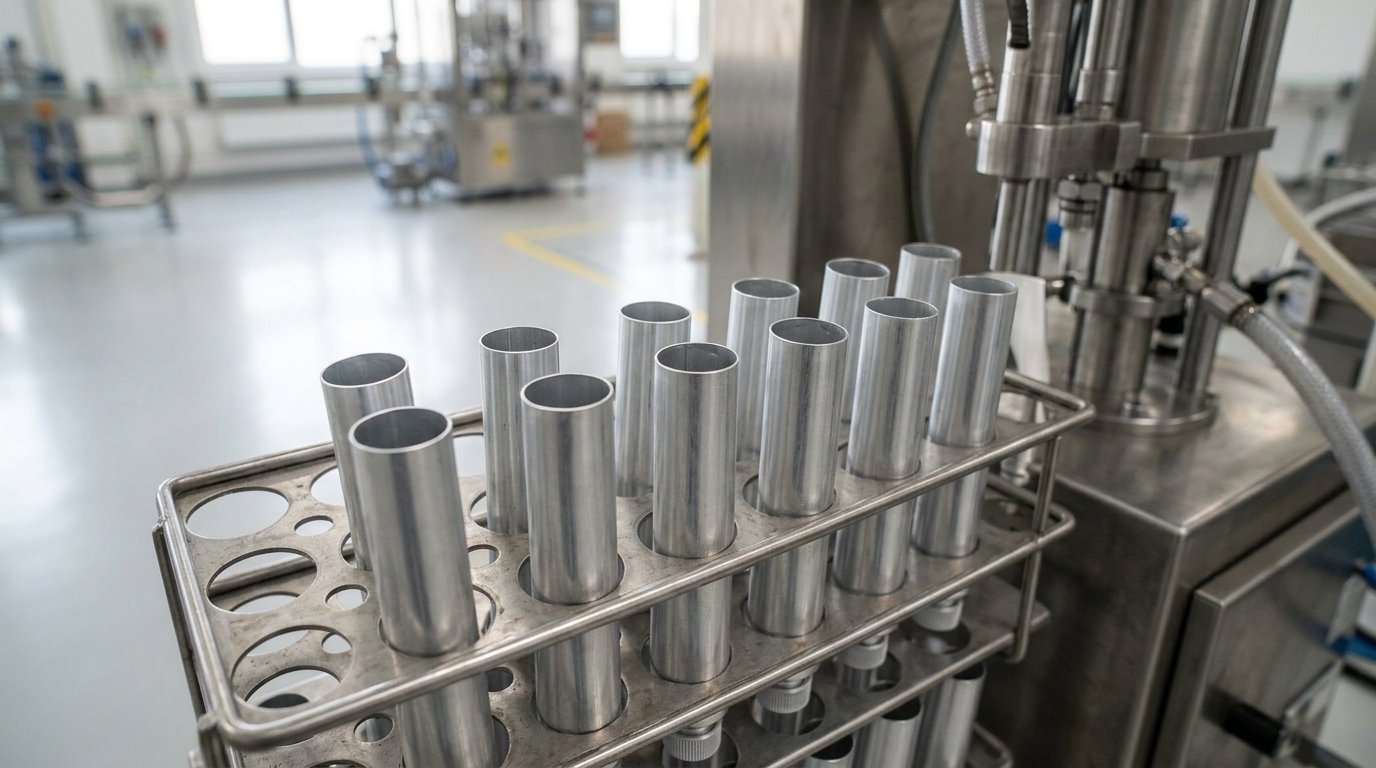
The tube is held by its diameter and body length. The pocket is cut to a tolerance band, so a tube that drifts outside that band either jams on entry or sits crooked before anything else can go wrong. Every later station inherits that bad position.
Interface two: the dosing nozzle
Product enters through the open tail or the shoulder opening. Orifice diameter, shoulder geometry and air displacement decide whether the fill is clean or smears product onto a surface that has to be folded a moment later.
Interface three: the fold station
Tail length, wall thickness and lacquer flexibility at the fold line decide whether the seal holds. The machine cannot adjust its way out of any of these. They are fixed when the tube is made.
Interface four: the capping head
Thread pitch, cap torque and flip-top orientation decide whether the closure seats square and stays aligned through shipping.
This is why “this machine handles aluminum tubes” tells you nothing. The same frame fitted with different pockets, nozzles and fold tooling is effectively a different machine for your tube. Each section below maps back to one of these four interfaces, so you can read selectively. If your pain point is leaks, jump to the fold. If it is scuffed print, go to the handling section.
The Tube Spec Sheet to Send Before You Ask for a Quote
Most machine-selection guides skip the step that prevents the most trouble: giving both the filler and the tube manufacturer the same tube-side numbers at RFQ stage. Imagine a buyer who quotes only the finished tube length. The filler tools the pockets to that figure, then the first tubes arrive with the open tail included in the real length and nothing fits. That mismatch is entirely avoidable. Send this list instead.
- Diameter with a tolerance. Never a bare nominal. The pocket is machined to a band, so state the nominal plus the range the tube manufacturer will hold.
- Finished length and tail allowance as separate figures. The length the machine cares about includes the open tail.
- Shoulder type and orifice diameter. Describe how the nozzle is meant to enter: open orifice, membrane, or a nozzle that seats against the shoulder.
- Thread designation plus the actual cap. Send a sample cap. The capping head is set up for a physical cap, not a thread spec on paper.
- Wall thickness and body stiffness. Stiffness controls how the tube behaves in the pocket and at the fold station.
- Print registration mark and orientation. A decorated tube must land the right way round, both for the print and for a flip-top to face the correct direction.
- A dimensioned drawing plus physical samples. A drawing and a sample are the only brief a filler can tool from without guessing.
- The full size range. If one line will run sample-size and full-size tubes, say so up front, because it changes pockets and changeover.
For scale, DOLYPACK lists aluminum collapsible tube sizes from 4ml samples to 200ml full-size tubes, and its customizable skincare tube range covers diameters of D11.5-D40 with a custom length range up to 200mm. Shapes include round, oval or customized profiles, and closures include flip-tops, screw caps or customized caps. Foshan Dolypackage Packaging Co., Ltd. holds more than 260 standard and non-standard molds, so the mold library is one of the first things worth asking about once you send the list above. Treat the drawing as a conversation to have at RFQ stage, not an assumption.
Dosing: Match the Fill Method to the Formula, Then Check the Tube Can Take It
Pick the dosing method from the formula, then ask what it demands of the shoulder and orifice. Doing it in that order means the tube is right before tooling, not patched afterwards.
| Formula type | Typical dosing method | Tube-side risk to design out |
|---|---|---|
| Thin, flowable: essences, toners, low-viscosity gels | Pump or gravity-assisted dosing | Drip at cut-off, and product sitting in the tail when the fold closes |
| Creams, hand creams, ointments | Piston or rotary piston dosing | Air pockets, and fill-weight drift when viscosity shifts with ambient temperature |
| Very thick or shear-sensitive products | Pressure feeding with a larger nozzle opening | The orifice and shoulder on the tube must change, not just the machine setting |
Fill accuracy belongs to a pair of things: the product plus dosing system, and the tube orifice it passes through. An accuracy figure quoted for a machine alone means little without knowing which tube it was measured on.
Viscosity also moves during the day. A cream that is stiff on the morning shift and looser in the afternoon shows up as fill-weight drift. An oversized orifice hides that drift, while a tight one exposes it. Neither is automatically right, but you want to know which one you are looking at.
So ask the filler which dosing method they will use before you finalise the shoulder and orifice, and write the answer onto the tube drawing. Hot filling raises a separate question about the inner lacquer and fold timing, which is next.
Fill Temperature, Cleaning, and the Inner Lacquer
The lacquer, the fill temperature and the cleaning cycle constrain each other. The filler does not need to choose the lacquer, but does need to give the tube manufacturer three things: the product chemistry, the fill temperature window and the contact time. Those three drive the coating recommendation. The coating chemistry itself is covered in our guide to aluminum tube internal coatings, so here the focus is how it interacts with the line.
Hot filling presses warm product against the lacquer at the exact moment the tube is being folded. The fold happens while the coating is at its most vulnerable. DOLYPACK describes its aluminum tube linings as BPA-free, safe and stable, but stable is always relative to a formula and a temperature, which is why the window has to be stated.
Cold filling moves the risk elsewhere. Product dwells longer in the nozzle, more of it clings in the tail, and the fold is made over residue instead of a clean surface.
Residue on the outside of the tube deserves its own warning. A dripping nozzle leaves product on the exterior, and it shows up later as a scuffed print or a fold that will not seal. It is a line fault that looks exactly like a tube fault, and the misdiagnosis turns into a dispute between the tube supplier and the filler.
Cleaning and changeover matter too. Ask what flush cycle the line runs, and whether the tube finish survives contact with cleaning agents and product residue during a shift.
The Tail Fold: Where Most Aluminum Tube Failures Are Born
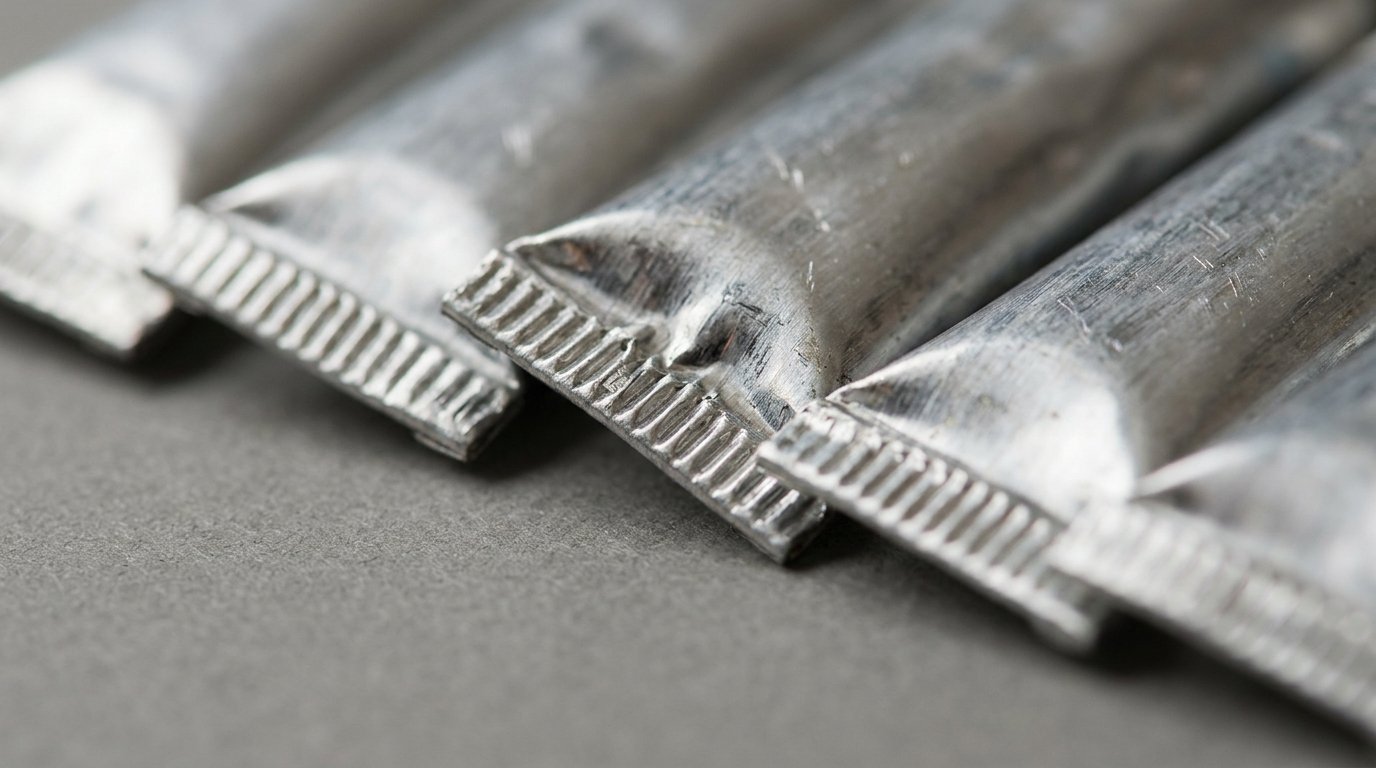
If a tube leaks, look at the fold first. Aluminum collapsible tubes close by mechanical folding and crimping, not by heat sealing. For a deeper look at leak causes, see our post on why aluminum tubes leak. Here is what to specify and what to challenge.
- Two actions, both dependent on the tube. The fold station folds the tail flat and presses a ribbed crimp into it. Tail length and wall thickness control both actions.
- Single fold versus double fold. A double fold turns the crimped edge back on itself for a tighter, more resistant seal. Choose it for the product, not because it is the machine’s default.
- A working window for tail length. Too short and the fold station has nothing to grip. Too long and the fold sits proud, wrinkles, or will not lie flat.
- What failure looks like. Wrinkles running along the crimp, a hairline crack in the lacquer at the fold line, uneven fold width across the tail, or a fold that springs partially open after a squeeze.
- Lacquer flexibility counts as much as tooling. Coating and fold have to be specified together, not in sequence.
- Confirm both sides agree. Ask the tube manufacturer which tail length and fold type they recommend for your product, then confirm the filler’s fold tooling is set up for that same combination before the run.
- Temperature changes the fold. Hot filling punishes impatience: a fold made on a warm, soft tail behaves differently from one made on a cool tube.
A vague fold spec such as “standard fold” should not survive review. If neither party can say which fold, which tail length and which tolerance, nobody owns the problem when a batch leaks.
Soft Bodies, Decorated Surfaces, and Cap Fit: The Handling End of the Line
Pure aluminum is soft, and that softness has consequences all the way from the magazine to the shipping carton. It dents and ovalises under mechanical handling, so pocket support and gentle transfer are line characteristics worth naming in the purchase conversation instead of assuming.
- Four places damage happens: the magazine feed, the transfer star wheels, the discharge chute, and the shipping carton.
- Decorated surfaces scuff against metal contact points. Specify which face may be touched and ask for the finish to be trialled on the actual line, not just inspected in a lab. Our comparison of matte, glossy and soft-touch finishes helps you weigh how each one tolerates contact.
- Non-round profiles need dedicated carriers. Oval and other profiles are available from DOLYPACK alongside round tubes, but confirm the filler has or will make tooling for that profile before committing to a shape.
- Cap torque is measured on filled tubes. A tube under internal pressure behaves differently at the thread than an empty one.
- Thread problems have two possible owners. Caps that cross-thread, back off in transit or sit visibly off-square can be caused on either side, so measure before blaming.
- Flip-top orientation is a capping-head setting. Settle it on the trial run, while a change to the head still costs nothing, rather than at full volume.
Run the Sample Trial: What to Test, Measure, and Put on Paper
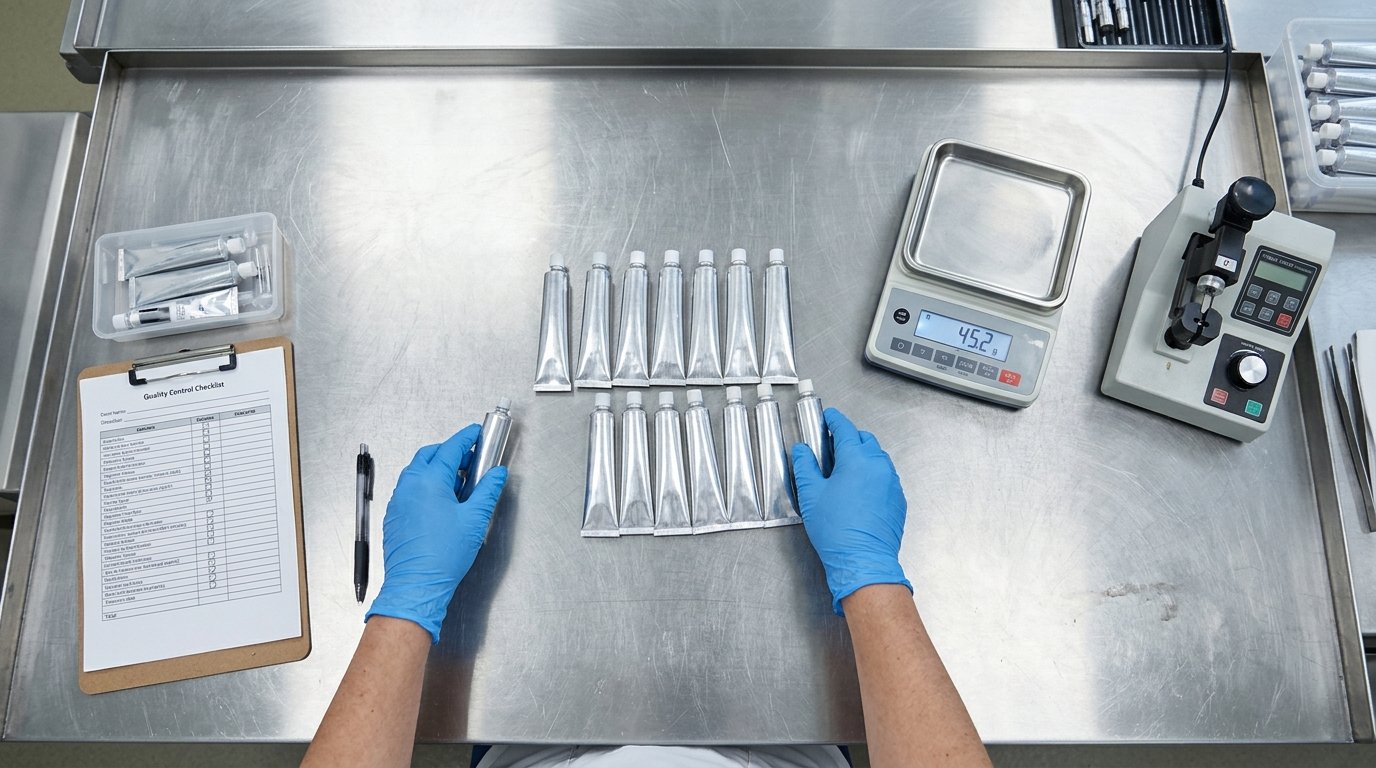
A trial turns a spec into evidence. A short, disciplined one is enough, and it can scale down to pilot runs and contract fillers.
- Use production tubes. Take them from the same batch and tooling as the bulk order. A hand-made lab sample proves nothing about a production tube.
- Run at real conditions. Run long enough to see a full magazine cycle and at least one size changeover, at the line’s real speed, not a slowed demonstration.
- Measure the fill spread. Record fill weight across the run, not just the average. The spread tells you whether the orifice and dosing method agree.
- Inspect every fold. Check fold width consistency and wrinkles on every tube in the sample, then squeeze-test filled tubes before and after a short hold.
- Check the caps. Measure cap torque on filled tubes and confirm each closure seats square and flush.
- Count rejects. Tally dents, ovality and scuffing after the run. A defect rate you measure is a defect rate you can negotiate.
- Document the run. Record tube batch, dimensions, coating, fill temperature, dosing method, line speed, machine settings and who attended, so the result can be repeated.
Scaling the trial for pilot runs and contract fillers
If you fill on a semi-automatic line or through a contract filler, run the same protocol at smaller volume. What changes is the batch size, not the checks. Ask about samples and low-quantity orders when comparing tube suppliers, so the trial happens before the bulk commitment. DOLYPACK lists samples and low-quantity orders for its plastic composite tube range alongside OEM, ODM and bulk options, so confirm the same availability for aluminum collapsible tubes when you request your quote.
Finally, get the tube manufacturer and the filler talking directly during the trial. Relaying messages through the brand loses the detail that solves problems.
Symptom to Cause: Is It the Tube or the Line?
A bad run should be traced, not argued about. This table separates the usual tube-side causes from machine-side causes for six common failure symptoms.
| Symptom | Tube-side causes | Machine-side causes |
|---|---|---|
| Leaks at the fold | Tail outside the agreed length window; lacquer cracked at the fold line; wall thickness below spec | Fold pressure; worn crimp tooling; fold timing |
| Dented or oval tubes at the fill station | Wall thickness below spec; compression damage from pack-out and transit | Magazine alignment; star wheel clearance; worn pockets |
| Fill weight outside tolerance | Orifice that does not match the nozzle; shoulder variation between batches | Dosing drift; product temperature change |
| Coating peel or blistering near the fold or shoulder | Lacquer not matched to the formula or fill temperature | Fill temperature above the agreed window; nozzle scoring the shoulder |
| Caps not seating, cross-threading or backing off | Thread out of spec | Torque setting; capping head alignment |
| Print scuffed or off-register | Missing orientation mark; finish not fully cured | Metal contact points; misreading registration sensor |
Resist re-tooling the line to compensate for a tube that is outside its own drawing. That fix feels productive, but it locks the next batch into the wrong baseline and moves the argument to the following order.
Before You Place the Order: Four Things to Put in Writing
Four documents carry everything above into production.
- One: a dimensioned tube drawing with tolerances, reviewed and agreed by whoever runs the filling line.
- Two: dosing method, fill temperature window and coating requirement written into the RFQ.
- Three: the trial record, with fill weight spread, fold inspection, leak check and cap torque signed off.
- Four: an incoming acceptance spec that names which dimensions are measured on arrival, how many tubes per lot are checked, and what happens to a lot that fails.
That last document is what keeps the second production run identical to the first. Consistency across repeat orders comes from the same drawing and the same acceptance spec, not from memory of how the first batch felt.
DOLYPACK manufactures custom aluminum tubes, aluminum bottles and aluminum packaging for cosmetic and personal care brands worldwide, with tube sizes from 4ml samples to 200ml full-size tubes and an R&D team of over 22 people at Foshan Dolypackage Packaging Co., Ltd. If you want a second pair of eyes on your drawing, send your filling line details, tube size and formula type through our custom packaging page, and ask for a matched custom tube recommendation before committing to volume.
Frequently asked questions
Do aluminum tubes need different filling equipment than plastic tubes?
Often yes, in the closing and handling stations. Aluminum tubes are folded and crimped mechanically instead of heat sealed, and pure aluminum is soft, so pockets and transfer need to support the body. One machine frame can run both materials only when it is fitted with the right tooling and tested with your tube.